Nature's Version of Hyaluronic Acid: Cacao and Tamarind Vinegar
Shannon WienerShare
Listen to the Green Blueprint
Young cacao, tamarind vinegar, and a different way to think about skin care.
Before we asked what cacao could replace, we asked what else it could become.
If you have spent any time exploring modern skin care, you have probably met hyaluronic acid. It is everywhere: on serum bottles, in moisturizers, and in conversations about plump, hydrated skin.
But at Sour Flower, our curiosity does not begin with an ingredient trend. It begins with the plants around us. What is growing? What is being overlooked? What happens when we bring something familiar into an entirely different kind of ritual?
We see the body as a living ecosystem, not a collection of separate problems waiting for separate products. That perspective shapes the way we cook, ferment, create, and care for ourselves.
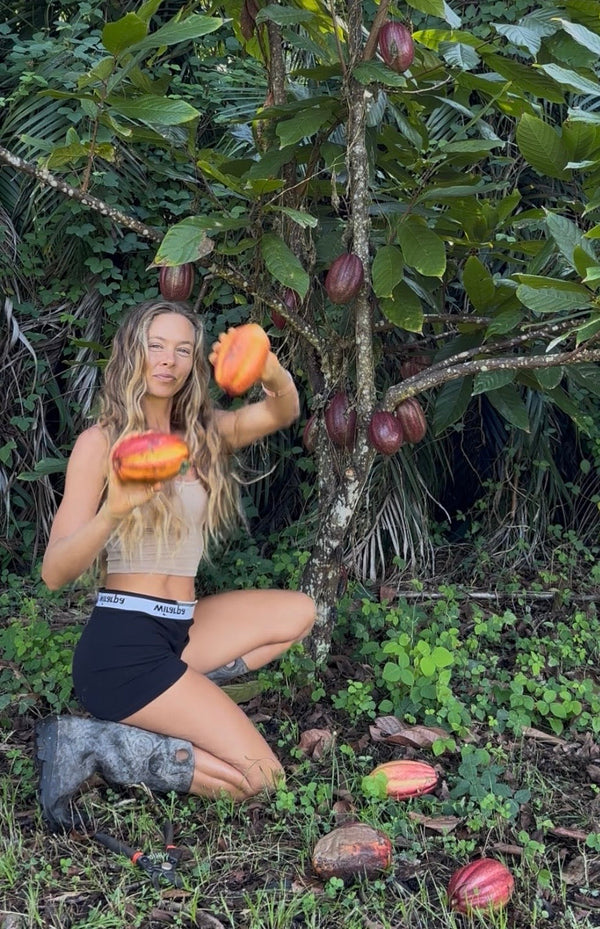
Our Young Cacao Serum grew from that philosophy. Whole, unripe green cacao pods meet a base of fermented tamarind vinegar, bringing us into the slippery, surprising world of cacao mucilage.
🌱 Cacao Before the Chocolate
Chocolate is only one chapter of cacao's story. Before roasting, grinding, and wrapping it in a beautiful label, there is a tree, a pod, developing seeds, and the plant material surrounding them.
We became fascinated with young green cacao and the mucilaginous texture we could draw from it. Mucilage is the wonderfully unglamorous word for slippery, gel-like plant material. Think less about the word and more about the sensation: soft, slick, and distinctly botanical.
Rather than treating that texture as something to separate from the plant's story, we followed it. We wanted to see what this overlooked stage of cacao could bring to a simple botanical blend.
🫙 Fermentation Is Our Starting Point
At Sour Flower, vinegar is not an afterthought. It is one of our favorite ways to explore transformation. Fruit becomes something new, with another character and another set of possibilities.
For this blend, tamarind vinegar became the base for steeping young cacao. Its acidity and the cacao's mucilaginous texture are central to the formula we developed.
This was hands-on work, not simply an idea we wrote down. We spent time observing, troubleshooting, and working with the way the vinegar and cacao behaved together. In our own development work, we found that the vinegar preserved the mucilage in the batches we followed.
That experience is part of this bottle's story. So is the patience of returning to an ingredient, paying attention, and letting what we observe shape what we make.
💧 A Different Path from Hyaluronic Acid
Hyaluronic acid is a water-binding ingredient used in many skin-care formulas. Our young cacao blend is something different: a preparation of botanical material in fermented fruit vinegar, rather than an isolated HA ingredient.
The comparison begins with texture and curiosity. Plant polysaccharides help create the slippery qualities associated with mucilage, while hyaluronic acid has its own distinct chemistry. They do not have to be the same substance for both to be interesting.
For us, the appeal is not that cacao can impersonate a familiar serum ingredient. It is that cacao offers another way to explore botanical skin care, with its own origin, character, and relationship to fermentation.
A little ingredient perspective
Different Ingredients. Different Stories.
🌿 Young Cacao + Tamarind Vinegar
The starting point: Young cacao pods and fermented tamarind vinegar.
The character: A slippery botanical preparation shaped by the ingredients and our steeping process.
Why we love it: It invites us to meet cacao beyond chocolate and vinegar beyond the kitchen.
💧 Hyaluronic Acid
The starting point: A defined water-binding ingredient, often produced through microbial fermentation.
The character: Available in different molecular weights and used in many kinds of finished formulas.
The distinction: Its properties do not automatically describe cacao mucilage, and cacao does not need to be HA to deserve our curiosity.
🍃 Tamarind Is More Than a Supporting Ingredient
Tamarind has a character all its own. Turning it into vinegar opens another chapter, and pairing that vinegar with young cacao gives us a meeting of two ingredients we are excited to work with.
You may have encountered tamarind in discussions of tartaric acid, or seen tamarind seed extracts in skin-care products. Those are useful starting points for learning, but a seed extract, fruit pulp, and fermented vinegar are different preparations.
Our bottle begins with the vinegar we actually make and the cacao we actually steep. We want to tell that story in its own language: fermentation, texture, observation, and the possibilities of plants.
🎨 Follow the Plant, Not Just the Trend
So much of modern shopping begins with being told what we lack. Another concern to fix. Another ingredient to memorize. Another bottle promising that the answer has finally arrived.
We would rather begin with a relationship. A tree in the backyard. Fruit shared by a neighbor. A texture that makes us stop and pay attention. Something abundant, something overlooked, something with a story still unfolding.
That is the spirit behind Sour Flower. We rescue surplus fruit, work with plants, and use fermentation as a creative language. Sometimes that leads to something for the table. Sometimes it leads us into a different kind of botanical ritual.
We are not interested in drawing rigid lines around what a plant is allowed to become. We are interested in looking closely enough to notice another possibility.
🌎 Care for the Ecosystem
Thinking of the body as a living ecosystem changes the tone of care. It invites attention rather than aggression, patience rather than a constant search for something stronger.
For us, that means making room for simple rituals and paying attention to how our skin responds. More is not always better. Neither is stronger. And discomfort is not something you need to push through to prove that a ritual is worthwhile.
Our interest in the skin's ecology guides the questions we ask and the things we create. It is a philosophy of care, curiosity, and respect for a system more complex than any single ingredient.
A little care goes a long way 🌿
Natural ingredients can still irritate sensitive skin. Follow the product directions, patch-test before broader use, and keep away from eyes and broken or irritated skin. Stop using it if irritation develops. This blend is not a sunscreen.
The Green Blueprint Is an Invitation
To us, the green blueprint is not a formula to copy. It is an invitation to notice what is already growing around us, to ask different questions, and to stay open to answers we were not expecting.
Young cacao does not need to become chocolate to be extraordinary. Vinegar does not need to stay in the pantry to remain part of our lives. And a daily ritual does not need a complicated story to feel meaningful.
Sometimes it starts with a green pod, a jar of fermented fruit, and the willingness to follow your curiosity.
Stay curious. Stay feral.